Milorganite® Fertilizer Turns 100
A Century of Growing Together
Milorganite fertilizer is 100! For a century, we’ve been growing alongside you — in your backyards, gardens, golf courses, and in communities across the country. From our humble beginnings to becoming a trusted partner in your landscapes. This milestone is about more than fertilizer — it’s about a shared legacy of sustainability. Celebrate 100 years with us and discover the story that got us here.
“The Milwaukee region embarked on a sustainability journey with the production of Milorganite in 1926,” said Milwaukee Metropolitan Sewerage District Executive Director Kevin Shafer. “At a time when others buried this byproduct, Milwaukee created a wonderful organic-based fertilizer that has endured for a century. Today, Milorganite is the gold standard for biosolid fertilizers.”
From Heavily Polluted Rivers to Clean Water and Milorganite
The demand for sewerage management and safe, clean water led to the creation of Milorganite, a nutrient-rich fertilizer used for 100 years.
In the early 20th century, Milwaukee was rapidly expanding. As the “Workshop to the World,”
Milwaukee was known for manufacturing industrial equipment and tools. The population grew alongside industry to provide the manpower. Increased manufacturing and more people created a lot more waste. At the time, Milwaukee’s rivers and Lake Michigan were treated more as open sewers than the vital resources we recognize today. Pollution became both an environmental and a human health issue.
A New Process for Wastewater Reclamation
In 1914, the newly established Sewerage Commission of the City of Milwaukee adopted the emerging biosolids (activated sludge) process for wastewater reclamation, which was being studied in Great Britain. This technology uses natural processes on an industrial scale to treat wastewater that can safely be returned to the environment. In the biosolids process, microorganisms are introduced to the wastewater to consume organic matter, which results in an abundance of nutrient-rich material.
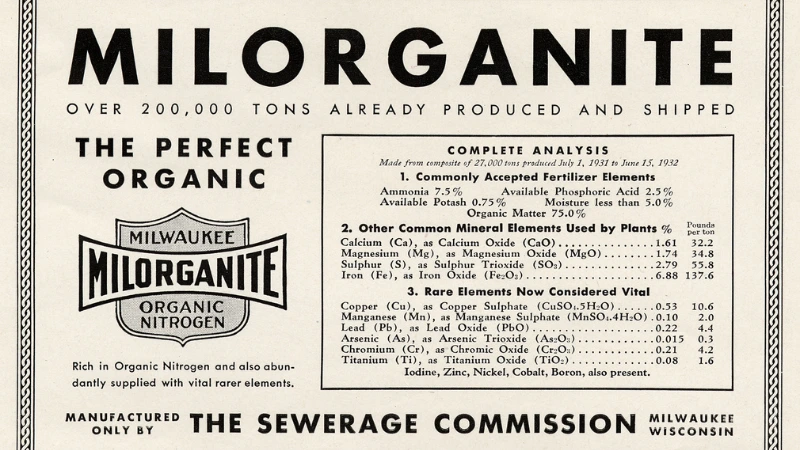
1932 Milorganite Fertilizer ad
In 1923, the Sewerage Commission began construction of the Jones Island Wastewater Treatment Plant, the world’s first large-scale biosolids-processing plant. That same year, the now Milwaukee Metropolitan Sewerage Commission established a fellowship at the University of Wisconsin College of Agriculture, directed by Oyvind Juul “O.J.” Noer, to study how the easy-to-apply, pelletized, nutrient-rich byproduct could be used successfully as a fertilizer.
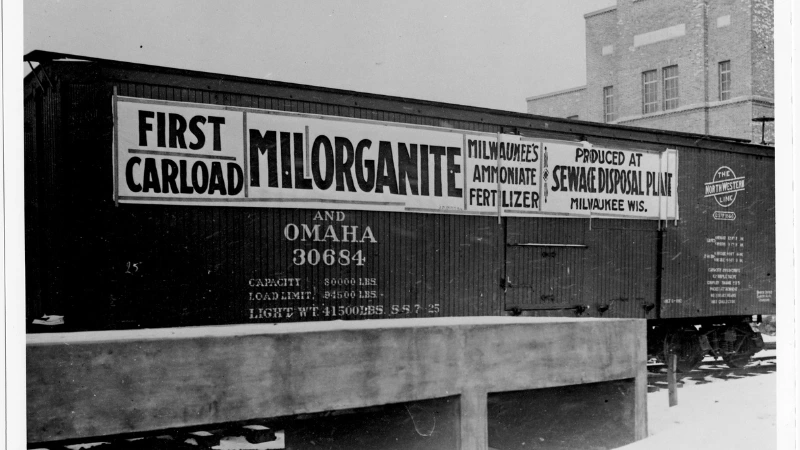
The first railcar of Milorganite shipped on February, 10, 1926
Noer established the first soil-testing laboratory in the country, and some of the testing protocols and evaluation tools he developed are still used today. He used extensive field trials to evaluate the product rather than relying on chemical analysis, as was common at the time. He was more interested in seeing the actual results of using the product.
By 1925, after testing the product on field crops and vegetables, the Sewerage Commission determined the product was a viable fertilizer that could be successfully produced, named and marketed, and would eliminate the need to dispose of the material in landfills. It was one of the first pelletized, multi-nutrient, dust-free fertilizers manufactured, a convenient and effective replacement for manure and single-nutrients that were typically used at the time.
Milorganite was first commercially produced and distributed in 1926. The biosolids process of water reclamation remains as much a pioneering technology today as it was in the early 1900s.
Why is it called Milorganite?
The name for this new slow-release, low-nitrogen fertilizer was chosen in a contest published in National Fertilizer Magazine in 1925. The winning entry was submitted by McIver and Son of Charleston, South Carolina, and is derived from MILwaukee ORGAnic NITrogen: Milorganite.
Milorganite possessed other qualities important to turfgrass professionals. It is ideal for low-nitrogen fertilization practices, releases nutrients slowly for consistent plant growth, and contains 85 percent organic material and essential micronutrients, including iron.
Word of Milorganite's success on golf courses spread across the country among superintendents. Noer was now certain it was a commercially viable fertilizer.
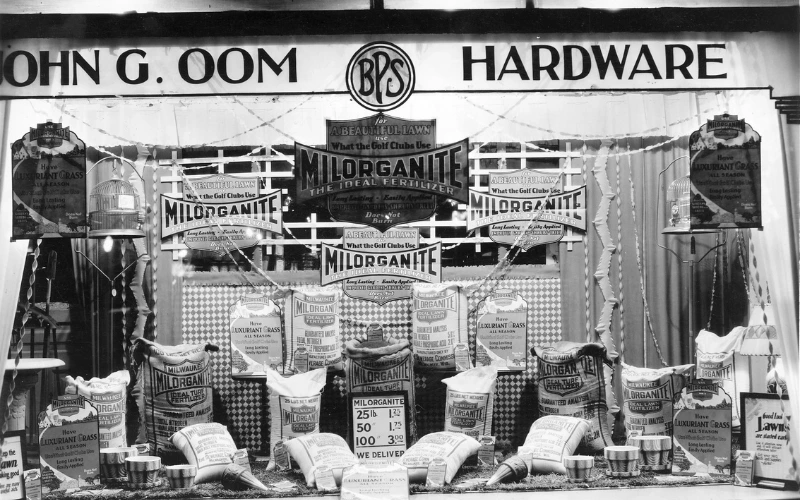
In 1927, Milorganite was exhibited for the first time at the International Golf Show in Chicago. More than 23,500 tons of Milorganite were sold that year. Milorganite sold for 25lb $1.25, 50lb $1.75, 100lb $3.00
Golf Superintendents Show Interest
Demonstrating the product’s viability as a fertilizer for crops, Noer turned his attention to studying its effects on turfgrass with great success. He demonstrated to superintendents two advantages of using Milorganite on golf course turf. It won’t burn plants, even if it’s not watered in, and it produces deep green, dense turf without excessive top growth.
Pioneering Turf Science
Noer is credited not only with demonstrating the effectiveness and commercial viability of Milorganite but also with being instrumental in establishing the turfgrass industry. Noer regularly spoke at professional turf conferences and authored many articles that were later published, The ABC of Turf Culture, one of the earliest books on turf maintenance. His status within the turf industry earned him the title “Mr. Turf” by the Golf Course Superintendent's Association of America.
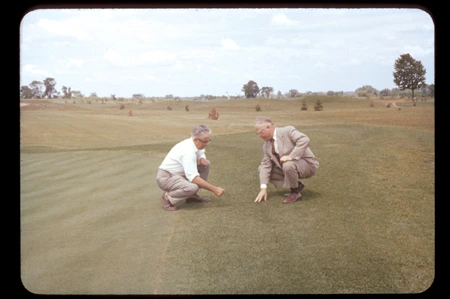
O.J.Noer (above) visited approximately 80 percent of the nation’s golf courses, sharing his vast knowledge with superintendents on identifying and treating turf problems using research-based methods.
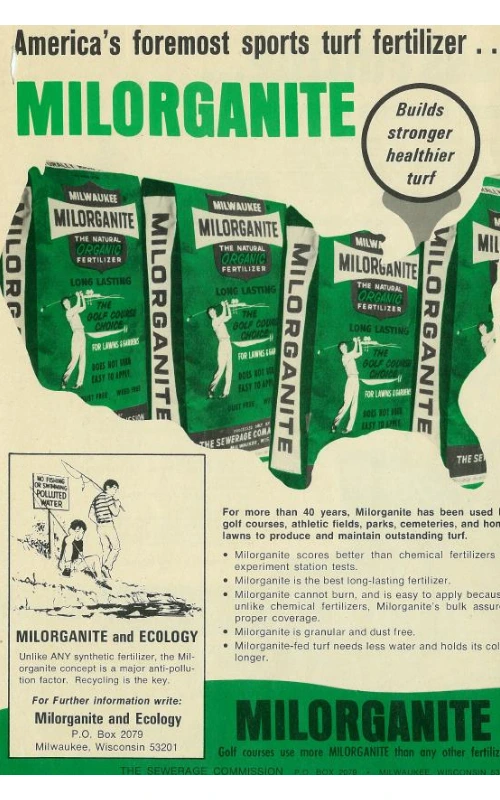
1971 Golf Magazine Milorganite ad
The Process of Manufacturing Milorganite
Nutrients in wastewater are recycled to produce Milorganite in one of the nation’s oldest and largest recycling efforts. Milorganite is composed of nutrient-rich, heat-dried microbes.
Using natural processes on an industrial scale, microbes are introduced into incoming wastewater during the activation process. Air is bubbled through the water to create a healthy environment for the microbes to digest the nutrients present.
Once the material has been completely digested and the microbes are out of food, they die. The clean water is returned to Lake Michigan. The dead microbes are dried in high-temperature rotary kilns heated to 900–1200 ⁰F to kill pathogens and form pellets. The result is Milorganite, the slow-release, low-nitrogen fertilizer consumers and professionals have grown to rely on for 100 years.
The nitrogen in Milorganite is slow-release, meaning it is water-insoluble. It gradually delivers nutrients to plants for up to 8-10 weeks for uniform growth and better-established root systems. Slow-release nutrients are also less likely to run off into waterways.
Milorganite complies with all federal and state standards where it is sold to protect public health and the environment. It is analyzed daily to comply with all applicable safety guidelines. After passing all tests, it’s ready to be packaged and shipped throughout the U.S. It can be used with confidence to fertilize turfgrass, landscapes, vegetables, and flowers.
MMSD’s Dedication to Environmental Stewardship
Milorganite products are manufactured and marketed by its parent organization, the Milwaukee Metropolitan Sewerage District (MMSD). A regional government agency recognized as a national leader in water reclamation, flood management, and green solutions serving more than 1 million customers in 29 communities.
Producing and distributing Milorganite is the most cost-effective solution for MMSD to achieve its goal of maintaining the health of waterways, the environment, and citizens by returning clean water to Lake Michigan and diverting material from landfills. Over the last century, MMSD has recycled those nutrients into Milorganite, returning them to beneficial use, keeping more than 10 billion tons of nutrient-rich byproduct out of landfills!
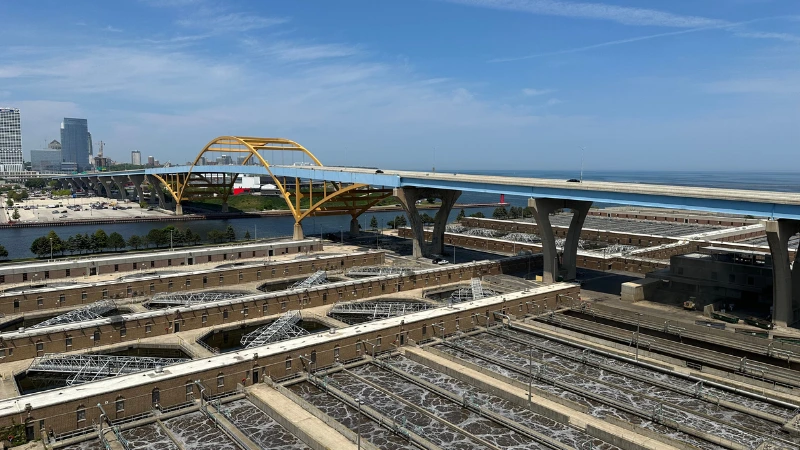
The Jones Island Water Reclamation Facility produces Milorganite fertilizer while cleaning Greater Milwaukee's wastewater and returning it to Lake Michigan.
A guiding principle for MMSD and Milorganite is to reduce the environmental impact of operations through sustainable practices. It continually seeks ways to reduce energy consumption, waste, and emissions.
MMSD continues to adopt alternative energy sources such as solar, landfill gas, and digester methane to reduce energy use and emissions. The goal is to have 80% of its energy supplied by renewable sources by 2035. Its landfill gas initiative has already significantly reduced its dependence on both natural gas and electricity.
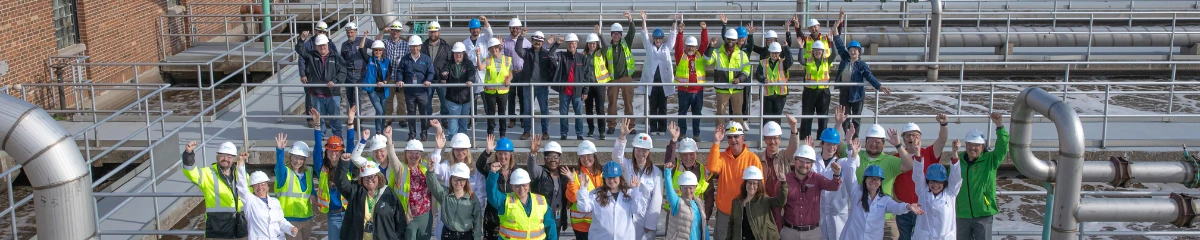
For 100 years, Milorganite has represented more than a fertilizer — it has symbolized innovation, stewardship, and a commitment to doing what’s right for both people and the planet. What began as a bold solution to a growing environmental challenge became one of the nation’s most enduring recycling efforts and a trusted product in landscapes across America.
As we celebrate this milestone, we honor the visionaries who saw opportunity where others saw waste — and we thank the generations of customers who have grown with us.
Enter the Milorganite® 100th Anniversary Giveaway
Share your Milorganite lawn, garden, or landscape, now until the end of September, and we'll send you a Milorganite 100th-anniversary t-shirt or hat. Join the celebration and show us what you’ve grown.